Switching costs are the money, time, hassle, and little annoyances that make changing provider harder than it first looks. You spot a cheaper broadband deal on your phone while waiting for a flat white, think “easy win”, then notice the exit fee, router return, engineer visit, and the fact that your TV discount disappears too. That is switching costs in real life, and once you understand them, it gets much easier to tell the difference between a genuine saving and a deal that only looks good from a distance.
What switching costs actually are
Switching costs are anything that makes moving from one product, service, or provider to another more expensive or more awkward. Sometimes that cost is obvious, like a cancellation fee. Sometimes it is less visible, like an hour spent on hold, a new app to learn, or the hassle of updating card details across half a dozen subscriptions.
Here’s the thing: “cost” does not just mean cash leaving your bank account. It can also mean effort, delay, stress, inconvenience, lost rewards, or the risk that something stops working for a day or two. If changing mobile provider means paying off the last part of your handset, requesting a PAC code, waiting for the transfer, and hoping your number ports cleanly, all of that counts.
A simple way to think about it is this: the sticker price tells you what the new deal costs, but switching costs tell you what the move costs.
Why switching costs matter when you’re trying to save money
The cheapest advertised price is not always the cheapest real-world option. A deal can be £8 a month less than your current one and still leave you worse off if you have to pay £90 to leave early, £25 for setup, and another £15 because you lost a bundled discount elsewhere.
That matters because household bills are recurring. A bad choice does not just cost you once. It can keep draining money every month because the move felt too messy, too confusing, or too risky to bother with. Plenty of people stay on expensive tariffs, insurance renewals, and phone contracts for exactly that reason.
The catch is that switching costs work in two directions. Sometimes they stop you leaving when leaving would save you money. Sometimes they push you into a new deal that looks cheaper, but only because the true cost of switching is hidden in the small print. In both cases, the headline price is only part of the story.
This is why switching costs matter so much when you are trying to cut expenses. If you ignore them, you can end up chasing “savings” that vanish on contact.
How switching costs work in real life
Switching costs work by adding friction to a change. Friction just means anything that slows the move down or makes you less likely to finish it. The more friction involved, the more tempting it feels to stay where you are, even if staying costs more.
That friction can be financial, practical, or emotional. A bank switch might be free in pure money terms, but if you need to update payment details everywhere, learn a new app, and worry about an arranged overdraft changing, the process suddenly feels heavier. A broadband switch might save money over a year, but if it comes with a two-week wait, an engineer slot, and the risk of a day without internet, the decision gets harder.
Providers know this. A service that is easy to join but fiddly to leave is not an accident.
The obvious costs
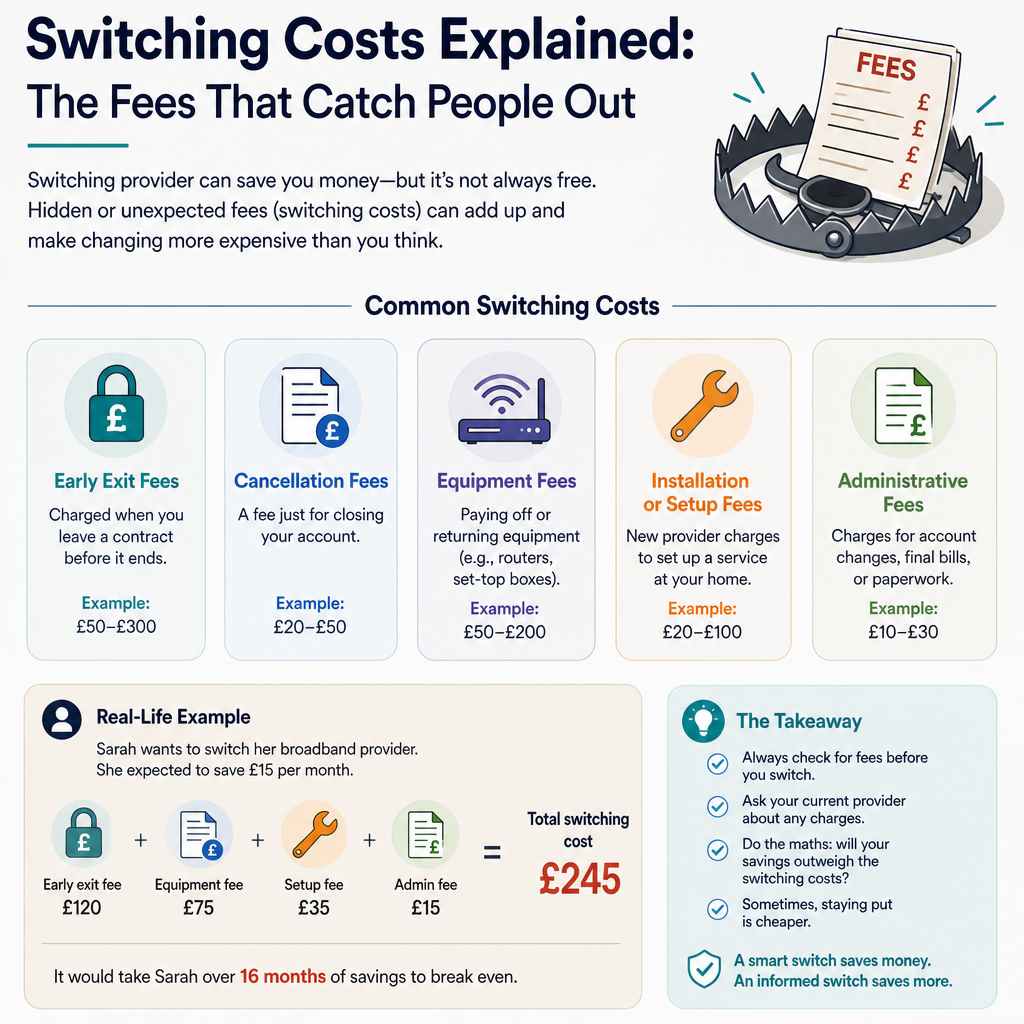
The obvious costs are the ones you can usually point to on a bill, contract, or checkout page. Exit fees are the classic example. Leave a broadband package six months early and you may be charged for part of the remaining contract. End a TV subscription before the minimum term is up and you may see a cancellation charge.
Mobile deals often include device payoff amounts if your handset is still being financed. Some providers charge setup or installation fees when you join. International money services may have transfer fees. Introductory offers can disappear the moment you leave or downgrade, which is another direct financial hit.
These costs are easier to spot, though only if you actually check the terms. If a provider says “from £24.99 a month”, that does not tell you much about the full leaving cost.
The hidden costs that catch people out
The hidden costs are usually where people get stung. Not because they are massive on their own, but because they pile up.
Time is a real cost. So is admin. Think about sitting on hold, filling in forms, proving identity again, passing a credit check, waiting at home for an engineer, packaging up an old router, printing a returns label, chasing a final bill, or redoing direct debits. None of that appears neatly as a line item called “switching cost”, but it still affects the value of the move.
Then there are knock-on effects. Split a bundle and another service can become more expensive. Cancel a current account and a linked regular saver or reward perk may disappear. Move cloud storage and you may spend an evening shifting files. Lose your saved watchlist, your playlists, your payment history, your preferences, and the move feels more annoying than it sounded at first.
That is why hidden costs catch people out. You do not notice them when comparing headline prices, but you definitely notice them on Tuesday evening when half the switch still is not done.
The main types of switching costs
Switching costs usually fall into three groups: financial, procedural, and relational. That sounds more technical than it is. It just means some costs hit your wallet, some hit your time, and some hit your comfort.
Financial switching costs
Financial switching costs are direct money costs. You can usually write them down in pounds and pence.
These include early termination charges on broadband or TV contracts, admin fees, setup or installation charges, postage costs for returning equipment, buying a new handset, paying a balance transfer fee on a credit card, or losing cashback because you leave before the qualifying period ends. If your current deal gave you a “free” extra that turns out not to be free once you cancel, that belongs here too.
These are the easiest costs to measure, which is helpful, but they are not always the biggest factor. A cheap switch with lots of hassle can still be a poor bargain.
Procedural switching costs
Procedural switching costs are effort costs. This is the work involved in making the move happen.
That can mean comparing deals properly, reading the contract, gathering account details, setting up a new account, transferring data, changing passwords, learning a different app, updating payment information, or waiting in for an installation. In banking, it may mean checking which subscriptions use which card. In broadband, it may mean scheduling a switch date that does not wreck your work-from-home setup.
These costs are easy to brush off because they do not show up on a statement. But your time has value, and hassle has a way of stopping good decisions halfway through.
Relational switching costs
Relational switching costs come from familiarity, trust, and habit. You know how the service works. You know where things are in the app. You know roughly how support responds. That comfort is worth something, even if it is not a formal fee.
Saved preferences matter. Reward history matters. A no-claims discount matters. Even the simple feeling that a provider is “fine” can keep you in place longer than the maths justifies. If a current account has years of transaction history and every payee already set up, moving away can feel more disruptive than moving to something objectively better.
This kind of switching cost is powerful because it rarely feels like a “cost” at all. It just feels easier to stay put.
The most common switching costs in household bills and everyday services
Some markets are full of switching costs, and household bills are near the top of the list. These are not abstract business concepts. They show up in everyday services you probably use every week.
Broadband, mobile, and TV packages
This is where switching costs often become obvious. Contracts tend to have minimum terms. Leaving early can trigger exit fees. Hardware may need to be returned, and missing the return deadline can mean extra charges. If your new service needs an engineer, you may need to take time off or wait at home through a long appointment window.
Bundles add another layer. A broadband, TV, and mobile package can be priced to make the whole thing look attractive, but the moment you remove one part, the rest can jump in price. A “cheap” broadband move can become less cheap if your mobile discount disappears with it.
Number portability helps with mobile, but only up to a point. If you are still paying for the handset, your lower airtime price may not matter much until the device balance is cleared.
Energy tariffs
Energy switching is often simpler than people expect, and industry changes have made the process more straightforward in many cases. Still, fixed tariffs can come with exit fees, especially if you leave before the end date. Ofgem explains that fixed-term tariffs may include exit fees.
There are also smaller details that matter. Your final meter reading needs to be right. Direct debit timing can create a short-term cash-flow wobble if a final payment leaves just before the refund arrives. None of this is dramatic, but it is still part of the real switching cost.
Bank accounts and credit cards
Bank switching feels bigger than it often is, partly because money is involved and partly because the admin seems endless. The good news is that the Current Account Switch Service handles a lot of the practical transfer, including moving many payments and closing the old account if requested. That reduces friction, but it does not erase every consequence.
If you use an overdraft, the terms may differ at the new bank. Reward schemes may work differently. Card details stored with subscriptions still need attention in some cases. If a credit card switch is involved, balance transfer fees and hard searches can change the value of the move. A tempting cashback or cash incentive may still be worth it, but only after you factor in the full picture.
Insurance policies
Insurance is full of small-print switching costs. Cancel mid-term and you may face an admin fee or cancellation charge. Time a new policy badly and you can end up paying for overlap in cover. Miss an auto-renewal date and you may get locked into another term before noticing.
For car insurance, protecting or building no-claims history can influence the decision. Home and pet insurance can bring similar issues, especially if extras and add-ons differ between providers. A lower annual premium is good, but not if the switch strips out cover you assumed was included.
Streaming, software, and subscriptions
These are often low-stakes individually, but the costs still add up. Annual billing can trap you into staying longer because leaving means wasting prepaid months. Free trials rolling into paid plans are a classic example of switching friction disguised as convenience.
There is also the comfort factor. Saved playlists, watchlists, family profiles, cloud storage, shared photo backups, and old files all make switching feel more annoying than the monthly price suggests. The service itself may only cost £7.99, but the mental cost of moving can be what keeps it going for another year.
High switching costs vs low switching costs
Low switching costs mean you can move without much money, hassle, or disruption. High switching costs mean leaving is expensive, time-consuming, risky, or some mix of all three.
A monthly subscription with no contract, no setup fee, easy cancellation, and no linked extras has low switching costs. A two-year broadband package with specialist hardware, a bundled TV discount, a return process, and an installation wait has much higher switching costs.
This matters because high switching costs can keep bad deals alive. If leaving is painful enough, plenty of people simply stay.
Signs a service has low switching costs
Services with low switching costs tend to be flexible by design. There is no long contract hanging over you. Cancellation is clear and easy. Setup is quick. Your data, number, files, or preferences are easy to move. Pricing is straightforward, and leaving does not break discounts somewhere else.
In practical terms, these are the easiest wins when cutting costs. If you can move with little downside, you only need to decide whether the new option is genuinely better.
Signs a service has high switching costs
High switching costs usually leave clues. Long minimum terms are one. So are specialist devices, installation visits, complex account setup, limited portability, reward schemes that punish leaving, or products that are deeply tied into other services you use.
If a provider makes it effortless to buy but confusing to cancel, that is another sign. So is any deal where half the value comes from staying inside a bundle.
Why firms use switching costs in the first place
Switching costs help firms keep customers longer. That is the plain version.
If leaving is awkward, expensive, or inconvenient, fewer people leave. That means a provider does not need to compete on price quite as aggressively, because some customers stay even when a better offer exists elsewhere. High switching costs can also make it harder for rivals to win your business, since a rival is not just competing against the monthly price. It is competing against your inertia, your habits, and the pain of changing.
That does not mean every switching cost is sneaky or unfair. Some are just part of delivering the service. Installing broadband takes work. Financing a handset creates a genuine balance to repay. But some costs are very clearly used as retention tools. Once you spot the pattern, deal pages start looking different.
Common misconceptions about switching costs
A lot of confusion comes from treating switching costs as nothing more than a line-item fee. That is too narrow, and it leads to bad decisions.
“Switching costs just mean exit fees”
No. Exit fees are only one part of the picture, and often not the biggest part.
If leaving a service costs £20 but takes three hours of admin, two missed calls, a new login setup, and a failed equipment return that has to be chased, the real cost is bigger than £20. Time, effort, stress, and lost convenience matter because they affect what the switch is actually worth to you.
“If switching costs are high, you’re always better off staying put”
Also no. A painful switch can still be a smart move if the long-term saving is large enough.
Think of it like replacing a draughty old fridge. The upfront faff is annoying, but if the ongoing cost of keeping the old one is high, staying put is the expensive choice. Recurring monthly bills work the same way. A rough switch that saves you £25 a month can quickly beat a one-off leaving cost of £60 or even £100.
“Loyalty always pays”
Loyalty is often expensive. That is the blunt truth.
Many firms save their best deals for new customers. Existing customers drift onto higher standard pricing, especially after intro periods end. The Financial Conduct Authority has highlighted concerns about the loyalty penalty in insurance markets, which tells you a lot. Staying put can be fine, but only after you compare the full cost of staying against the full cost of leaving.
How to work out whether switching is still worth it
You do not need a giant spreadsheet to decide. A quick, honest calculation usually gets you most of the way there.
Add up the true leaving cost
Start with every cost attached to the move. Include exit fees, installation charges, lost rewards, overlap in payments, postage or travel for returns, and any balance still owed on equipment or a handset. If a bundled discount disappears, count that too.
Then add a rough value for your time. Not a perfect one, just a sensible one. If the switch will take two hours of admin and a half-day waiting for an engineer, that effort belongs in the total. A back-of-envelope figure is enough.
Compare that with the real saving
Next, work out what you will actually save across the full term, not just in month one. If a broadband deal is £18 a month cheaper for six months but only £4 cheaper after that, use the full pattern. If an intro rate jumps sharply after the first year, include that. Ofcom advises checking the contract terms, notice period, and price rises before switching broadband or mobile.
This is where plenty of “great deals” fall apart. Intro prices are persuasive. Full-year totals are more honest.
Check the break-even point
Break-even simply means the point where the savings from switching finally cover the cost of moving.
Say leaving broadband early costs you £70, and the new provider charges £20 setup. Your total switching cost is £90. If the new deal saves you £15 a month, you break even after six months. Before month six, you are still catching up. After month six, the saving becomes real.
That one calculation changes the decision. If you expect to move house in four months, the switch may not be worth it. If you plan to stay for two years, it probably is.
Simple examples of switching costs in action
The idea makes more sense when it is attached to ordinary situations.
Example: leaving broadband early for a cheaper deal
Picture a broadband contract with eight months left. Leaving now costs £96. The new provider charges £15 for setup, but the monthly bill would drop from £39 to £24.
Your switching cost is £111. Your monthly saving is £15. You break even after a little over seven months. If you plan to stay in the property for at least a year, the switch likely pays off. If your contract would have ended in six months anyway, waiting could be smarter.
Example: moving banks for a cash incentive
A bank offers £175 to switch. Sounds easy.
But your current account has an arranged overdraft at a rate that suits you, and several subscriptions are tied to your debit card rather than direct debit. If the new bank’s overdraft terms are worse, or if a missed card update causes a late payment elsewhere, the bonus loses some shine. The cash incentive still may be worth grabbing, but only if the account works for your actual day-to-day use.
Example: changing mobile provider after a handset deal
Your SIM-only equivalent elsewhere is £12 cheaper each month, but your current deal still has £240 left on the handset. If you need to clear that balance to leave, the lower monthly airtime cost does not tell the whole story.
At £12 saved per month, it takes 20 months to recover £240. If the handset would be fully paid off in 10 months anyway, switching immediately may not be the best move. The maths, not the advert, should decide.
How to avoid getting caught out by switching costs
The good news is that switching costs are often predictable once you know where to look. The trick is to check before you click, not after.
Check the contract before you click “buy”
Look for the minimum term, cancellation rules, notice period, and any price rise clauses. If the deal includes “free” extras, check whether those extras disappear or become chargeable if you leave early. Citizens Advice recommends checking exit fees, contract length, and what happens at the end of a fixed deal.
Boring? Yes. Worth five minutes? Absolutely.
Watch for bundles and linked discounts
Bundles are where switching costs love to hide. Broadband can be tied to TV, mobile, or landline discounts. Bank accounts can unlock linked savers or cashback perks. Insurance add-ons can make one policy look cheap only because it is connected to another.
Before changing anything, check what else moves with it. One switch can quietly affect three bills.
Keep your own simple switching checklist
A short checklist saves money because it forces the deal into plain English. Keep these points in your notes app before any switch: contract end date, notice period, exit fee, setup fee, downtime risk, direct debit changes, and total first-year cost.
That last one matters most. If you only compare monthly prices, you miss the trap.
FAQs about switching costs
Are switching costs always monetary?
No. Money is only one type of switching cost. Time, hassle, learning a new system, changing saved details, waiting for appointments, and losing convenience all count as well. In some cases, those non-cash costs are the main reason a switch does not happen.
Are switching costs legal in the UK?
Many switching costs are legal in the UK if they are clearly set out in the contract and applied fairly. Exit fees, setup charges, and cancellation rules are common examples. If a charge is unclear, hidden, or seems unfair, it can be challenged. The Competition and Markets Authority says contract terms and practices must be fair and transparent.
Can high switching costs stop competition?
Yes, in some markets. If leaving is hard enough, a cheaper or better provider has to overcome more than price alone. High switching costs can make competition weaker because people stay put even when better-value alternatives exist.
What is the easiest kind of service to switch?
Usually, it is a service with no long contract, no hardware, no setup visit, and easy portability of your data or number. Monthly subscriptions with clear cancellation terms tend to be simpler. But “easy” still depends on the small print, especially if discounts or bundled extras are involved.
The one thing to try before your next switch
Before cancelling anything or signing up for a shiny new deal, total the full leaving cost and the first-year saving on one piece of paper or in your notes app. That single habit catches the fees and faff most people miss, and it turns switching costs from a nasty surprise into a decision you control.