Imagine cutting your electricity bill just by plugging something into a normal 3 pin socket. That is exactly what a plug in balcony solar kit lets you do.
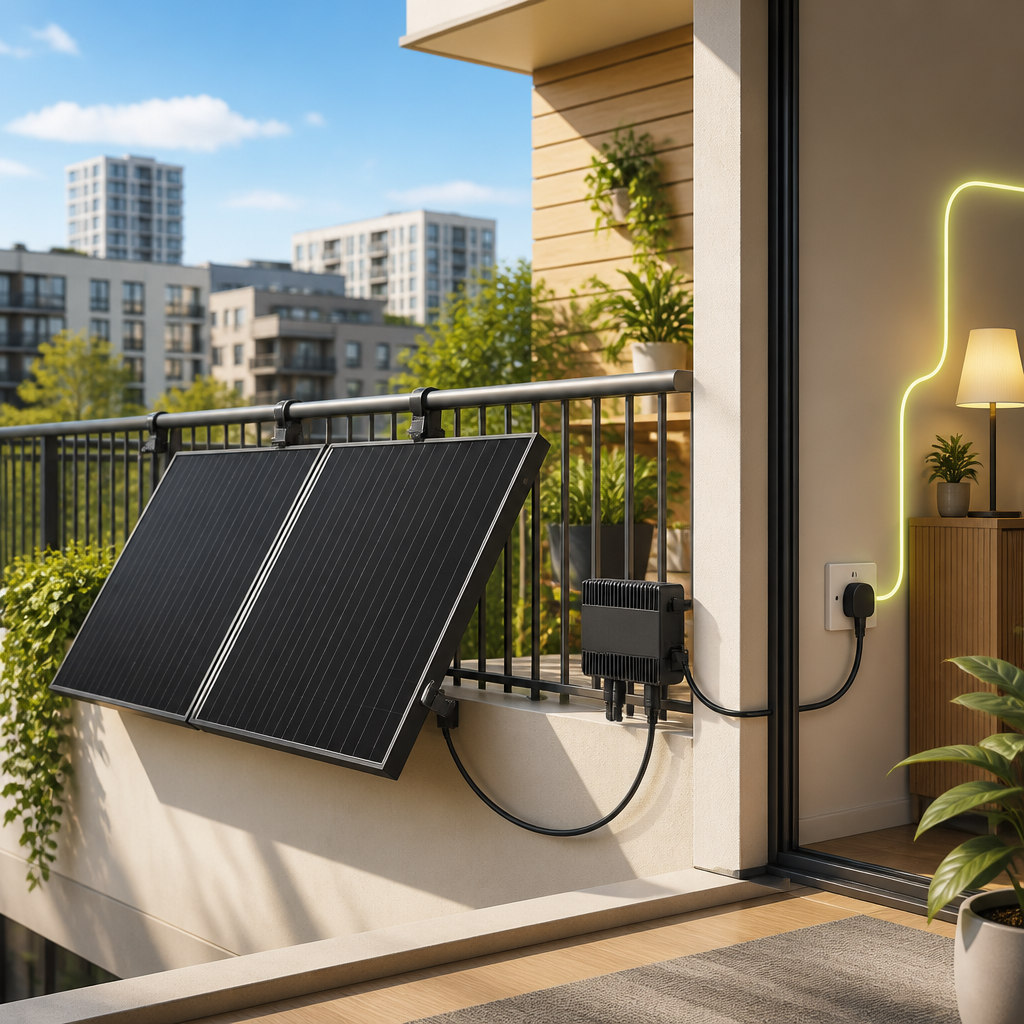
Instead of a big, complex roof system, you get a compact set of solar panels plus a small microinverter that work together as a mini power station. You mount the panels on a balcony, terrace, fence or in the garden, then connect the kit to a standard UK socket. When the sun shines, the system quietly feeds clean electricity straight into your home.
The big benefit is simple. Every unit of solar power you use is one you do not have to buy from your energy supplier. With UK electricity prices still high and unpredictable, even an 800 W kit can make a real dent in your daytime usage, especially if you work from home or have appliances running all day.
There is no need for scaffolding, no planning a full roof installation and no major changes to your home. A plug in balcony kit is a low commitment way to try solar, start shrinking your bills and see how much free power you can get from your own space.
What is included in an 800W balcony and garden solar kit
A typical 800 W balcony and garden solar kit is designed as a complete, ready to plug in package, so you are not hunting around for extra parts.
At its heart are the solar panels, usually two larger modules of around 400 W each or several smaller ones that add up to roughly 800 W. These sit outside and turn sunlight into DC electricity.
Next is the UK Voltacon microinverter. This small box usually mounts close to the panels. It takes the DC power from the panels and converts it into 230 V AC that matches your home supply. The microinverter constantly synchronises with the grid so your solar power blends seamlessly into your household circuits.
Mounting options are included or available for railings, balcony fronts, terraces, fences or low garden frames, so you can angle the panels safely and neatly. The kit also comes with suitable outdoor cabling, connectors, and a lead that ends in a standard UK plug for a 13 A socket, plus basic fixings and instructions.
The result is a tidy, compact system that fits well on typical UK flats and houses, even where space is tight.
How plug in solar works, from sunlight to free electricity
Here is what happens when your balcony kit is at work.
Sunlight hits the solar panels and they generate direct current, or DC electricity. This flows straight into the Voltacon microinverter, usually fixed close to the panels. The microinverter converts the DC into 230 V AC, the same type of electricity your home already uses.
The clever bit is that the microinverter synchronises with your home supply, matching the grid’s voltage and frequency. When you plug the kit into a standard 13 A socket, the solar power simply joins your home’s wiring, just like a tiny personal power station.
Your appliances do not know the difference. Anything running at that moment, kettle aside, will automatically draw the solar electricity first. Your fridge freezer, Wi Fi router, TV and laptop can all be running on your own solar power while the sun is shining.
If your kit is generating, say, 500 W and your home is using 500 W or less, you are importing little or nothing from the grid at that moment. If you are using more, the solar covers part of the load and you only buy the difference, which is where the bill savings appear.
Safety, approvals and plug in simplicity in the UK
Safety is a big concern for many people, so it helps to know that these kits use UK approved solar panels and a certified Voltacon microinverter that is designed to meet UK grid standards. The microinverter is the “brains” of the system and it constantly checks the quality of the electricity it is sending into your home.
Plug in balcony kits are built to connect to a normal 13A UK socket when used as the manufacturer intends. There is no need to rewire your house. You mount the panels securely, plug the kit into a suitable socket, then the system quietly does its job in the background.
Modern microinverters include important safety features such as anti islanding. If the grid goes off, the inverter instantly stops exporting power. This protects engineers working on the lines and keeps your home system within regulations.
It is wise to read the installation guide in full, follow the checklist, and if you are unsure, speak to your local Distribution Network Operator or a qualified electrician. For most households, there is no major electrical work needed. The whole idea is a safe, simple plug in experience.
How much you could save with an 800W plug in kit
In typical UK conditions, an 800W balcony kit can generate roughly 600 to 900 kWh of electricity a year, depending on where you live, how sunny your spot is and how well the panels are angled. Even at the lower end, 600 kWh at 25p per kWh is about £150 a year off your bill. At 900 kWh, you are nearer £225 a year in savings, just from letting the sun hit your panels.
You save most when you use the power as it is being produced. That is why daytime home workers, parents at home and retired people usually gain the most. Their everyday usage matches solar output, so less electricity needs to come from the grid.
An 800W kit is ideal for steady background loads. On a bright day it can cover a fridge freezer, Wi Fi router, a few lights, a TV and device chargers, with ease for many hours. If you can also time flexible tasks like vacuuming, ironing or running a slow cooker for the middle of the day, even more of that energy becomes free electricity instead of a line on your bill.
Choosing, installing and living with your balcony solar kit
Choosing where to place your kit makes a big difference. Aim for a south or south west facing balcony, wall or garden spot with as little shading as possible from trees, nearby buildings or railings. Even moving a kit a metre or two to avoid shade at midday can boost your generation.
Installation is usually straightforward. Secure the panels using the supplied brackets or frame so they cannot move in strong wind. Route cables neatly, avoiding tripping hazards or sharp edges, then plug the microinverter lead into a suitable 13A socket that is in good condition. Work through the manufacturer checklist step by step and keep the manual handy.
Once it is running, a few simple habits help you get the most value. When you can, run the washing machine, dishwasher or tumble dryer in the late morning or early afternoon. Keep the glass on the panels clean with a soft brush or cloth and check the fixings now and again.
A compact balcony or garden solar kit is an easy first step into renewable energy. Plug it in once, build a couple of sunny day habits, and you can enjoy years of lower bills powered by your own slice of sunshine.