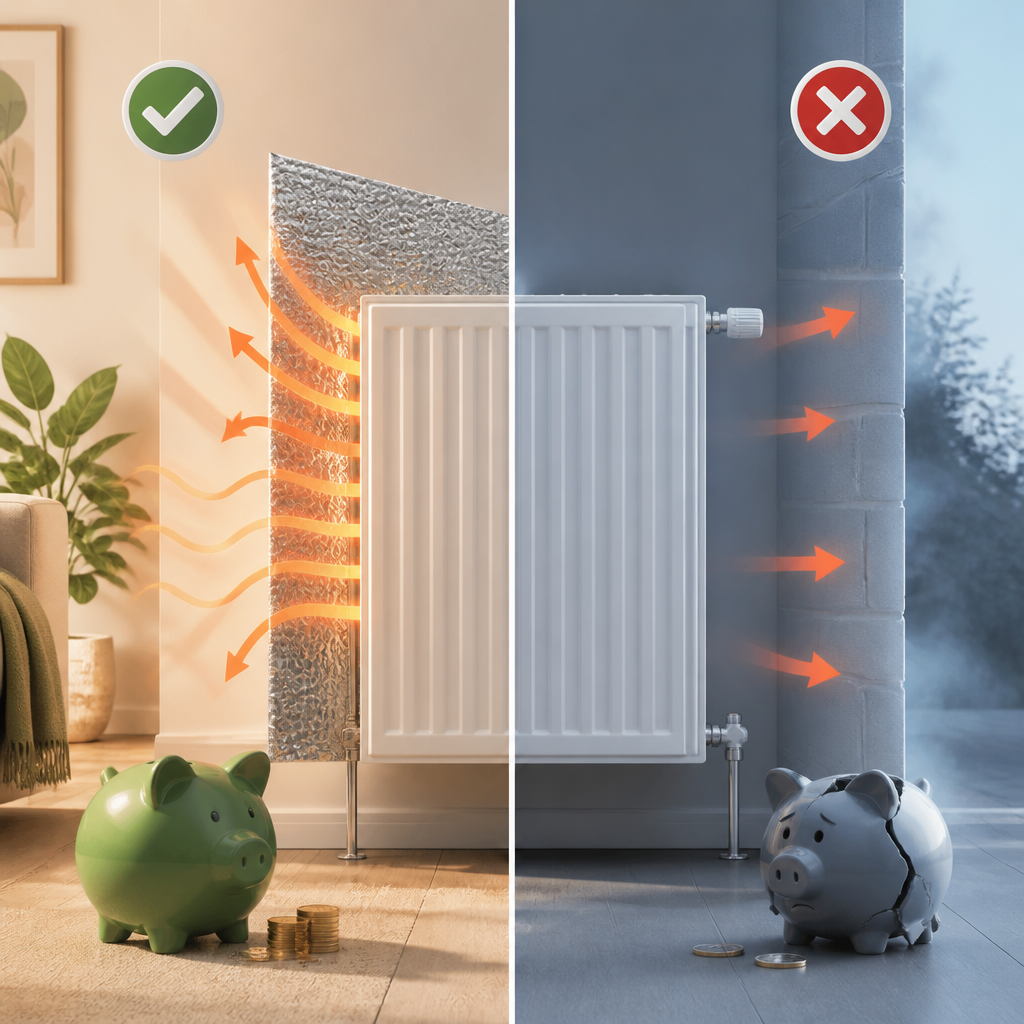
Heating bills keep creeping up, and many people are hunting for anything that cuts costs without tearing the house apart. One of the simplest ideas you will see online is radiator reflector foil: a shiny sheet that sits behind your radiator and promises to bounce warmth back into the room instead of letting it leak into the cold wall.
In plain terms, radiator foil is a thin reflective and slightly insulating layer that you place between the radiator and the wall. The shiny side faces the radiator so more of that heat ends up in your room, not soaking into brick or concrete you never feel.
It is important to be clear about what it is not. Radiator foil will not turn a leaky old house into a cosy eco‑home, and it will not compete with proper wall insulation or a modern, efficient boiler. Its job is much smaller: to squeeze a bit more comfort and efficiency out of the radiators you already own.
So the real question is: when does radiator reflector foil genuinely save you money, and when is it just another overrated hack? Spoiler: in the right kind of home, with the right product, it can help. But it is not a miracle for every radiator or every wall.
How radiator heat and reflector foil really work
Radiators warm your room in two main ways. First is convection, they heat the air, which then rises, circulates, and slowly warms the space. Second is radiation, they send infrared heat in straight lines to nearby surfaces, like your furniture, your legs and, unfortunately, the wall behind them.
If a radiator sits on an outside wall, a chunk of that radiant heat goes straight into the cold wall instead of the room. The wall then leaks that energy outdoors. You have paid to heat the great outdoors, and you feel cooler than you should for the boiler time you are using.
Radiator reflector foil tackles this. The shiny surface reflects a lot of that radiant heat back into the room, and the backing layer slows how much warmth soaks into the wall.
The type of foil really matters. Standard kitchen foil or any random shiny wrap tears easily, conducts heat rather than resisting it, and is not designed or tested for this job. Proper radiator foil usually pairs a reflective aluminium face with a thin layer of closed cell insulation, which is what actually cuts the heat loss into the wall.
When radiator foil actually saves you money
Radiator foil tends to shine in older homes with solid, poorly insulated external walls, especially where radiators are fixed directly to those cold walls. In that setup, a lot of heat is usually soaked straight into the brick or stone, so there is more waste to claw back.
If your external walls already have decent insulation, either inside or outside, there is simply less heat escaping through them. Foil can still help a little, but the extra gain is smaller because the wall is already doing most of the work.
Independent tests and small studies generally agree on the pattern: modest but real reductions in heat lost through the wall behind the radiator, often a few percent of the heating energy for that room. Over a whole winter, especially in colder climates where the heating is on for months, that can add up to a noticeable trim on your gas or oil bills.
The effect is always local. Foil only helps the radiators you actually treat, so you will feel it most in homes with several radiators on external walls. Many people notice the biggest benefit as comfort, for example a living room that feels warmer at the same thermostat setting.
Choosing the correct radiator reflector foil
First, skip the kitchen foil. It is flimsy, tears when you slide it behind the radiator, can trap moisture against the wall and has not been tested for this job. A shiny surface on its own is not enough, and you could end up with more hassle than benefit.
Look for a product that is sold specifically as radiator reflector foil or radiator insulation. It should have a reflective metallic face, usually aluminium, bonded to a thin, closed cell insulation such as foam or bubble wrap. That combo reflects radiant heat and slows heat soaking into the wall.
Check the packaging for fire safety information and building standard notes. Good products state they are safe behind hot water radiators, give a maximum temperature rating and are suitable for indoor use on masonry or plasterboard.
Purpose made kits often come as pre cut panels or a simple roll, plus adhesive pads or strips, which makes fitting much easier if you are new to DIY. The cost per radiator is usually modest, so in a poorly insulated home that runs the heating a lot, the payback time can be relatively short.
How to install it for best results
For radiator foil to work properly, it needs to sit between the radiator and the wall, shiny side facing the radiator, covering as much of the heated area as you can without being visible around the edges.
Start by turning the heating off and letting the radiator cool. Measure the width and height of the hot part of the radiator, then cut the foil slightly smaller than this so it stays hidden behind it.
There are two common ways to mount it. The simplest is to stick it directly to the wall with the adhesive pads provided. Alternatively, if your brackets allow, you can hang or wedge it from the brackets so it “floats” behind the radiator. In both cases, try to keep a small air gap between foil and radiator, and ideally between foil and wall, as this helps performance.
Stay safe: do not cover bleed valves, thermostatic radiator valves or block airflow around the top and sides.
Avoid crumpling the foil, running it all the way up the wall above the radiator, or using aggressive tape that will rip paint or plaster. For most people it is a straightforward DIY task, and you can usually do several radiators in an afternoon.
Is radiator foil right for you? A quick checklist and conclusion
A quick yes or no guide:
- Are your radiators on outside walls?
- Does the wall behind them feel cold to the touch in winter?
- Do you know there is no internal wall insulation behind them?
- Do you run the heating regularly for long periods?
If you are ticking several of these, good quality radiator foil is likely to help. Just keep expectations realistic. You are looking at helpful but not life changing savings, a small percentage off your heating use rather than a bill that suddenly halves.
Treat radiator foil as one of several low cost tweaks that work together. Pair it with bleeding your radiators, fitting or using thermostatic radiator valves, nudging room temperatures down by a degree, and sealing draughts around windows, floors and doors.
Start with one or two important rooms, typically the living room or main bedroom. Fit foil, then pay attention to how quickly the room warms up and how often the boiler fires, before rolling it out elsewhere.
Bottom line: with the right foil on the right wall, you can cut heat loss a little, feel warmer, and gently lean on your bills. It is a cheap, low risk first step into making your home more energy efficient.